The Role of Carrier Tape in Automated Manufacturing
In developing automated manufacturing processes, effort often focuses on capital-intensive equipment that determines throughput, precision, and uptime. This includes automated feeders, robotic handling, machine vision, and other production equipment.
There may be less discussion about the transportation and assembly presentation media linking suppliers, production steps, and customer processes together. These materials feed components at high-speed to automated systems and bring completed output to the next stage. However, as components become smaller, more complex, and more demanding to handle, their movement through manufacturing becomes increasingly important.
Carrier tape provides that precision, protection, and consistency needed to keep multi-stage automated production moving. It’s a continuous strip of formed material containing individual pockets. The pockets are designed around a component’s geometry, intended presentation orientation, and handling requirements.
Regularly spaced indexing holes run along the tape edge. Automated equipment uses these holes to advance the tape at controlled intervals. This movement positions each pocket accurately for component loading, inspection, assembly, or singulation.
Think of movie film, but with formed pockets instead of picture frames.
After components are placed into the pockets, cover tape is sealed over the carrier tape. The loaded tape is then wound onto a reel. Together, the carrier tape, cover tape, and reel form what is commonly referred to as “tape & reel.”
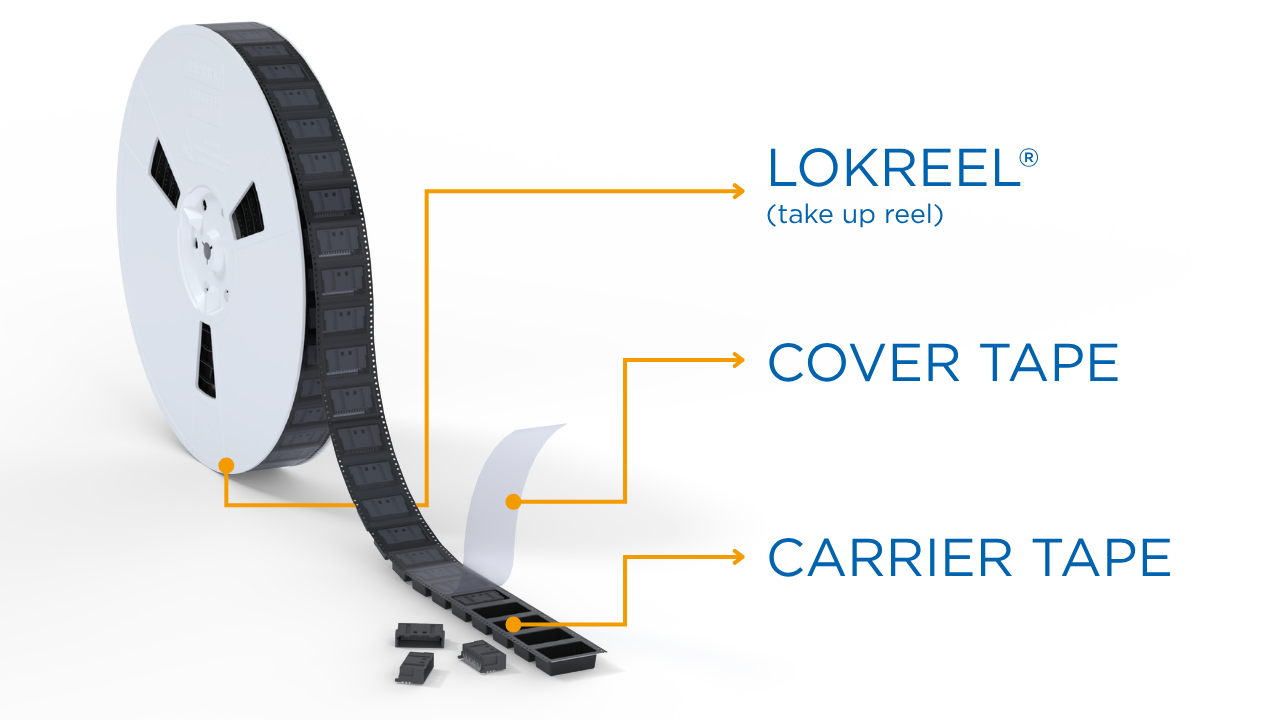
Carrier tape is rarely visible in finished products, but it enables manufacturing across many industries. Its controlled presentation reduces variability and supports reliable, high-speed feeding, inspection, and placement.
For small, fragile, irregular, or electrostatic-discharge-sensitive components, that consistency is especially important. These components may be difficult to handle manually or inspect reliably at production speed.
Carrier tape addresses those challenges before the component reaches the equipment.
Supported to Scale Across Industries
Standards such as EIA-481 and IEC 60286 define tape & reel packaging dimensions and configurations. This supports compatibility across suppliers, equipment platforms, production stages, and regions.
Tape & reel is closely associated with semiconductor and electronics manufacturing. But its principles equally support automotive electronics, telecommunications, medical technologies, and other precision applications.
Each application may require different materials, pocket features, or protection levels. However, the manufacturing need remains consistent. Components must arrive protected, correctly oriented, and ready for automated handling.
As industries move toward greater precision and automation, carrier tape will remain an important manufacturing facilitator. It supports the consistency customers need to bring their next-generation products to market.
Advantek supports customers across the tape-and-reel process, from pocket design through material selection and application support.
Our global manufacturing network provides the capability, consistency, continuity, and capacity required for demanding applications at scale.